Category: News Page 3 of 15

Birdwatching at Kranji Marshes on World Animal Day, Sat 4 Oct 2025

The majestic Grey-headed Fish Eagle, the Daurian Starling and the Little Bronze Cuckoo were among the beautiful species spotted at the special conservation area in Kranji. 

Article by Melissa De Silva 

Photos by Teresa Teo Guttensohn, Seetha Sharma and Melissa De Silva 

It was my first time birding, at the kind invitation of Dr Denise Dillon, as part of the private bird watching tour in the Core Conservation Area at Kranji Marshes she purchased during an auction at the 70th Anniversary Gala Fundraising Event of the Nature Society of Singapore in October 2024. Though I didn’t own a pair of binoculars, I wanted to be in the presence of nature, the plants and animals, and learn more about birds. Like many people living in urban Singapore, the few birds I was familiar with are those commonly seen in our built up landscape—mynahs, pigeons, crows and the Terkukor (Spotted Dove). 

We met early on Saturday 4th October 2025, on World Animal Day, at the parking lot of the Sungei Buloh Wetland Reserve and piled into a van that shuttled us to a specially designated conservation area usually closed to the public, ten minutes away, led by volunteer bird guides from Nature Society Singapore, Wing Chong and Wee Jin. Wee Jin told us that peak migratory season for the birds runs from the end of October to early November.

It turned out that my lack of binoculars, or a telephoto lens for my mirrorless camera, didn’t matter. Wee Jin had a telescope and invited us to take turns looking at the birds. Among the birds we saw at our first spot were a male Common Flameback (a woodpecker) on a rain tree, looking very dapper with his red mullet, the Lineated Barbet with its stunning green body, and the resplendently coloured Stork-billed Kingfisher, the largest kingfisher in Singapore, with its teal body, orange throat and red beak. 

As we moved on to a second spot, more birds came into view or were recognised by their calls. Three types of parakeet—the Long-tailed Parakeet, the Rose-ringed Parakeet and the Red-breasted Parakeet. The first is a globally endangered native species, while the other two are non-native, introduced residents of Singapore. There was also an Oriental Magpie-Robin, a beautiful songbird frequently captured for its song, and several juveniles of the Asian Glossy Starling. 

The Grey-headed Fish Eagle photographed through the telescope using only a smartphone, one of the most memorable sightings of the day.
A Grey-headed Fish Eagle perched on a stark, leafless tree rising from the water, an elegant silhouette against the marshland landscape.
Quick facts on the Grey-headed Fish Eagle, a rare resident raptor requiring tall, mature trees for nesting.
Some of the notable bird species spotted at Kranji Marshes, including both residents and early migrants.

After some time, I began to wish I did have a lens to photograph the birds so I could remember them and enjoy their beauty later. That turned out not to matter either. Soon, Wee Jin showed us a neat trick to capture the images in the telescope, using just our smartphones!

At one point, while we were walking on the path along the marshy water body, we spotted a Grey-headed Fish Eagle perched on a bare tree rising from the water in the distance. Its craggy shape flowed almost seamlessly into the stark silhouette of the tree. 

Teresa Teo Guttensohn scans the marshland landscape through the telescope, searching for raptors and other resident birds.

In itself a rare sight, the eagle rested on the branch for an uncommonly long time while we gazed at it through binoculars or the telescope and took photographs. Wee Jin explained that eagles make use of thermalling to save energy to soar to greater heights. This thermal soaring involves the eagles gliding on columns of warm air (thermals) to carry them to higher altitude and over long distances for hours, without having to expend energy flapping their wings. 

Wee Jin told us that all the raptor birds of Singapore—including the Brahminy Kite and the White-bellied Sea Eagle—can be seen in the Kranji marshes. 

The Grey-headed Fish Eagle is a globally endangered raptor that is a native resident of Singapore, said Andrew Tay, co-founder of Cicada Tree Eco-Place. He spoke on the importance of conserving old, tall trees which are crucially needed by eagles to build their nests.

Besides birds, we passed the Simpoh Ayer plant (Dillenia suffruticosa), with yellow flowers and veiny leaves used to wrap tempeh. Also the Sea Hibiscus tree that has yellow flowers with a maroon throat, and the Sea Almond tree, whose ripe seeds taste like, yes, almonds. On the walk back, we passed long grasses with a cloud of Yellow-barred Flutterer dragonflies, identifiable by the yellow and black bars on their hind wings, which made me think of bees. 

In the van, Wee Jin gave us a summary of the trip. In the short span of three hours, we had collectively seen a total of 41 bird species. Notable species were migrants like the Daurian Starling, also known as Purple-backed Starling. The Daurian Starling, a small bird with a greyish, dark body and white wing bars, usually appears in big groups. There was the Blue-throated Bee-eater with its chestnut head and the blue-black Oriental Dollarbird. At one point, a flock of Asian Glossy Starlings winged by above us. 

Two Blue-throated Bee-eaters perched on a high bare branch, one of the striking migrant species seen during the walk.

Among the impressive resident birds were the Grey-headed Fish Eagle and the Changeable Hawk-Eagle and the very special Little Bronze Cuckoo spotted at the end of the trip, not a common sight.

Teresa Teo Guttensohn, co-founder of Cicada Tree Eco-Place, remarked that it was highly unusual to see the variety of birds we had in one outing and that we had been very lucky. As I watched the conservation marsh area with its avian denizens recede in the distance as the van pulled away, I felt exactly the same. 

About Melissa De Silva

MA Arts & Ecology student at LASALLE College of the Arts – a transdisciplinary programme for those who seek to explore critical environmental discourses. Singapore Literature Prize Winner 2018 (Creative Nonfiction) for ‘Others’ is Not a Race. Melissa is an author, and has worked in journalism and publishing.

Cicadas: The Chorus of Summer in Singapore and Japan

By Foo Maosheng & Teresa Teo Guttensohn
12 May 2025

Our rare and gorgeous native Black and Gold Cicada (Huechys fusca) is found in the rainforests of Singapore, the Malay Peninsula, Sumatra and Borneo. PHOTO: Nicky Bay

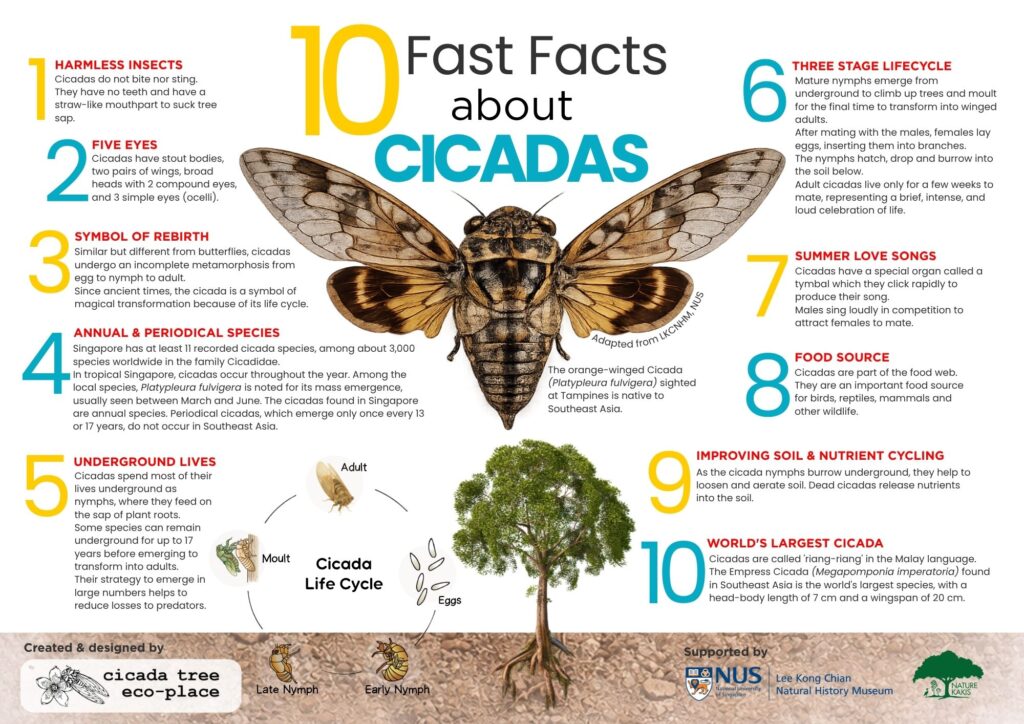
Recently the shrill mating songs of cicadas at Tampines town in Singapore have drawn media attention, residents’ annoyance and unwarranted fear. Many are unaware that these harmless little critters (insects related to leafhoppers) have emerged from mother earth to signal to us the natural change in seasons.

The Chorus of Summer

In Japan during summer, the chorus of cicadas has become a cultural hallmark —an auditory signal of the changing seasons. Despite the noise, cicadas there are widely accepted as a part of summer life, often evoking a sense of nostalgia which one may have seen in Japanese films and anime.

Like springtime cherry blossoms, cicadas are a symbol of the transcience of nature due to its short lifespan, and of rebirth and transformation.

“Singapore Got Seasons Meh?”

Singapore experiences the Inter-monsoon Period from late March to May with light and variable winds, interacting with land and sea breezes. Thunderstorms, at times severe, and hot, humid afternoons are common.

Unlike the 13- and 17-year periodical cicadas found in North America, which emerge in synchronised broods (in the millions or even trillions!), the cicadas in Southeast Asia and Singapore emerge more irregularly, often triggered by climatic conditions like rainfall and humidity.

Cicadas are Harmless to Humans

In Singapore, the sudden appearance of cicadas in large numbers can be quite overwhelming, especially if one does not understand that cicadas are harmless to humans. Cicadas do not bite, sting, or transmit diseases. In fact, they play a valuable ecological role.

The sudden intrusion of flying cicadas into homes may startle residents, especially those with a natural fear of insects. This reaction is understandable—cicadas are large, noisy, and tend to fly erratically, sometimes into personal spaces. Their sheer numbers during emergence events can also magnify this discomfort.

Loudest Insects in the World

Cicadas hold the record of being the loudest insects in the world! As they only have a few weeks to find a mate, male cicadas sing loudly to attract females, and to defend themselves and protect their territories.

It is understandable that those living near areas with large numbers of cicadas may experience auditory fatigue and discomfort, especially due to the prolonged exposure to their loud mating calls throughout the day.

While it can be stressful, this natural spectacle of mass emergence is also a fascinating event — one that reminds us of the hidden biodiversity around us.

A Remarkable Natural Phenomenon

Rather than viewing them as a nuisance, perhaps we can begin to see cicadas as a brief but remarkable reminder of the natural rhythms that still persist in our urban environment.

Impact of Climate Change on Cicadas and other Insects

Insects like bees and cicadas play crucial ecosystem roles. Climate change-related disruptions to insect populations can have cascading effects on pollination, plant health, and other ecosystem services. 

Rising temperatures and changing weather patterns can potentially disrupt the periodic emergences of cicadas. 

With habitat loss and impact of climate change, how much longer will we be able to hear the striking summer songs of cicadas?

More info:
https://cicadatree.org.sg/about/learn-about-cicadas/

Contributors

Foo Maosheng is the Curator of Insecta at Lee Kong Chian Natural History Museum, National University of Singapore

Teresa Teo Guttensohn is the Co-founder of Cicada Tree Eco-Place.

World Water Day 2025 – Survival Strategies and Water Stories

Text by Teresa Teo Guttensohn and Pui Cuifen, Photos by Andrew Tay

“Saving our glaciers is a survival strategy for people and the planet.” – United Nations, 2025

Cicada Tree Eco-Place observes World Water Day 2025 on 22 March.

The theme of UN World Water Day 2025 is ‘Glacier Preservation’. Even though Singapore is in the tropics and doesn’t have glaciers, we’re deeply connected to them through the global water cycle.

Glaciers store about 70% of the world’s freshwater. Increased glacier melting is contributing significantly to global sea-level rise, which affect’s Singapore low-lying areas.

Many regions depend on glaciers for freshwater, including countries that export food to Singapore. Changes in water availability can affect ecosystems, biodiversity, and availability of food.

Water is essential to the health of soil, forests, seas, oceans, and all living organisms. Nature’s water cycle moves water from land and ocean surfaces to the atmosphere and back to Earth’s surface. Humans have disrupted the water cycle in many parts of the world, leading to increasingly frequent and severe rain, floods, droughts, and fires.

What can we in Singapore do?

•⁠ ⁠Support regenerative land practices and reforestation practices to help enhance the health of soil and forest ecosystems

•⁠ ⁠Reduce our personal carbon and water footprints through making more sustainable lifestyle choices

•⁠ ⁠Advocate for policies that protect climate-vulnerable ecosystems

Akan datang! Watch this space to join our upcoming Water Story community film screening organised by Cicada Tree Eco-Place and Food Citizen. (Date, Time & Venue TBA)

“Climate change will present a new challenge for this generation and the next. Singapore will be subjected to unpredictable weather such as prolonged and more frequent dry spells, posing a risk to our water supply. We must respond with the same fortitude and determination as our pioneers to write the next chapter of Singapore’s Water Story.” – Grace Fu, Minister for Sustainability and the Environment (Source: PUB)

++++

“Glaciers are melting faster than ever.

As the planet gets hotter, our frozen world is shrinking, making the water cycle more unpredictable.

For billions of people, meltwater flows are changing, causing floods, droughts, landslides and sea level rise.

Countless communities and ecosystems are at risk of devastation.

As we work together to mitigate and adapt to climate change, glacier preservation is a top priority.

We must reduce greenhouse gas emissions to slow down glacial retreat.

And, we must manage meltwater more sustainably.

Saving our glaciers is a survival strategy for people and the planet.” – United Nations (Source: UN)

Why Our Brains Are Designed To Ignore Climate Change — CNA

Catch Dr Denise Dillon on this CNA documentary – Why Our Brains Are Designed To Ignore Climate Change | Who Cares About Polar Bears.

Climate change is said to be possibly the worst problem for the human psyche to handle. What is it about the human psychology that creates deniers, despairers and doers? Why is it so hard to get humanity to care enough to do something about climate change compared to other issues? How can we harness behavioural science to “trick” the human mind into taking action against climate change?

In “Who Cares About Polar Bears?”, husband-and-wife team Edward Choy and Jo Tan take viewers through an exploration of cognitive theories, putting participants through experiments and activities. They find out from psychologists how we can hack our brains to change our behaviour. They also speak to businesses, NGOs and individuals who are changing the way they address sustainability in order to encourage more people to take action that helps the planet.

Page 3 of 15

Powered by WordPress & Theme by Anders Norén