Submission is now closed. The deadline was extended to 10 July. Please note that only designs featuring native, endangered wildlife will be eligible.
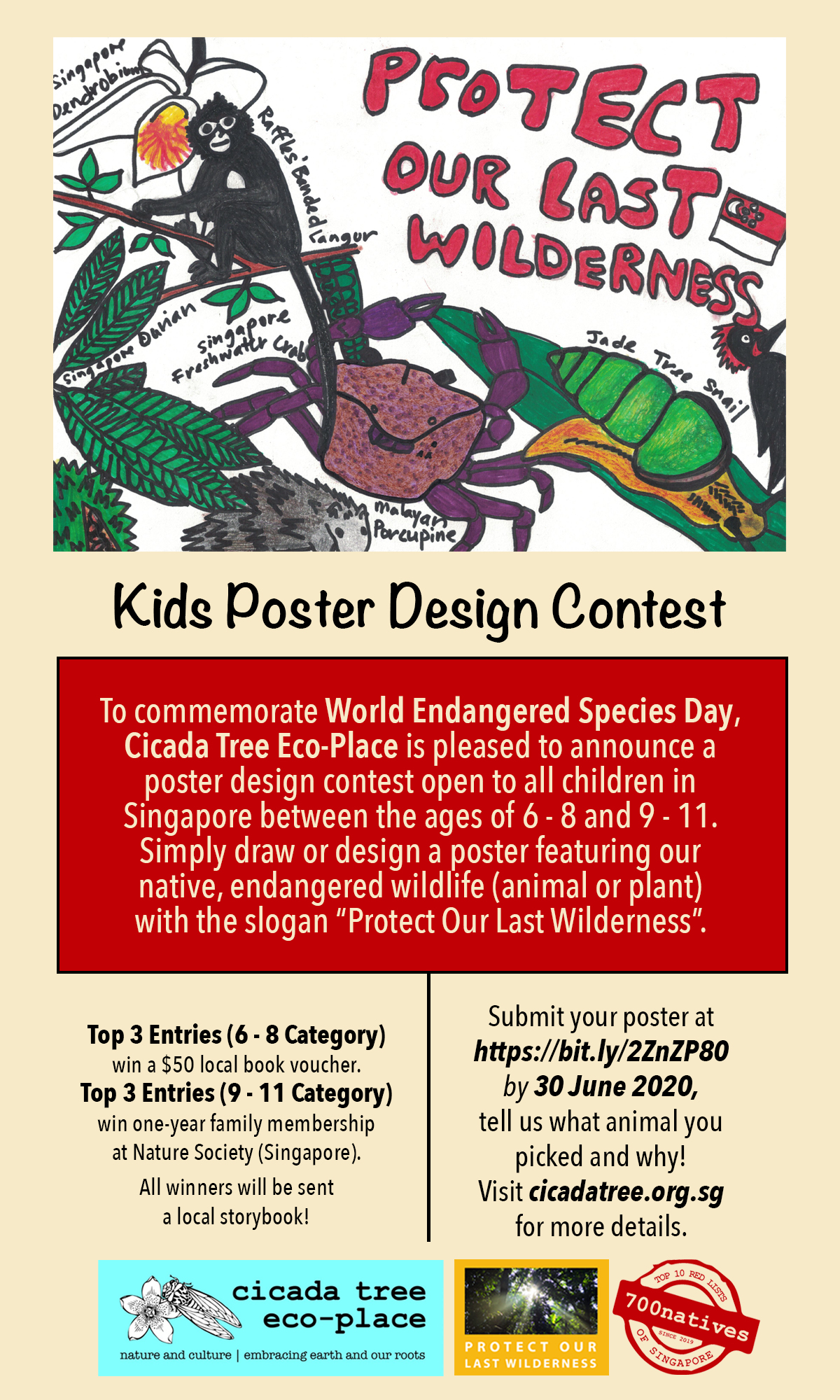
To commemorate World Endangered Species Day, Cicada Tree Eco-Place is pleased to announce a poster design contest open to all children in Singapore between the ages of 6-8 and 9-11. Simply draw or design a poster featuring our endangered native wildlife with the slogan “Protect Our Last Wilderness” for a chance to win a prize!
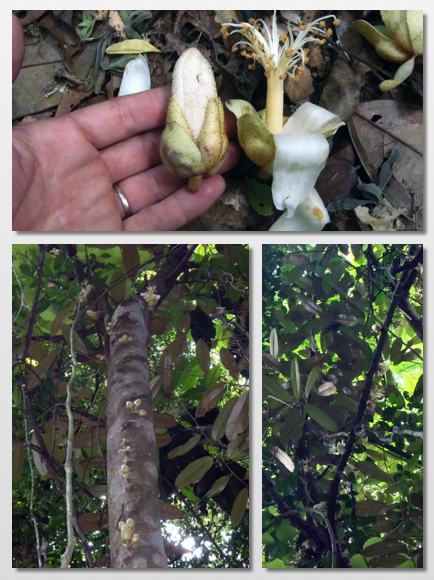
Singapore Durian (Durio singaporensis) flowers, tree trunk and leaves. Photos: Lua Hock Keong.
by Teresa Teo Guttensohn
Hey kids! Did you know that we have our very own native and rare durian trees in Singapore?
One of them has special leaves and is named after our country. It’s called – you guessed it! – the Singapore Durian (Durio singaporensis). The leaves are green on top and have a metallic brown underside. From below, it looks like a bronze leafy umbrella – how cool is that?
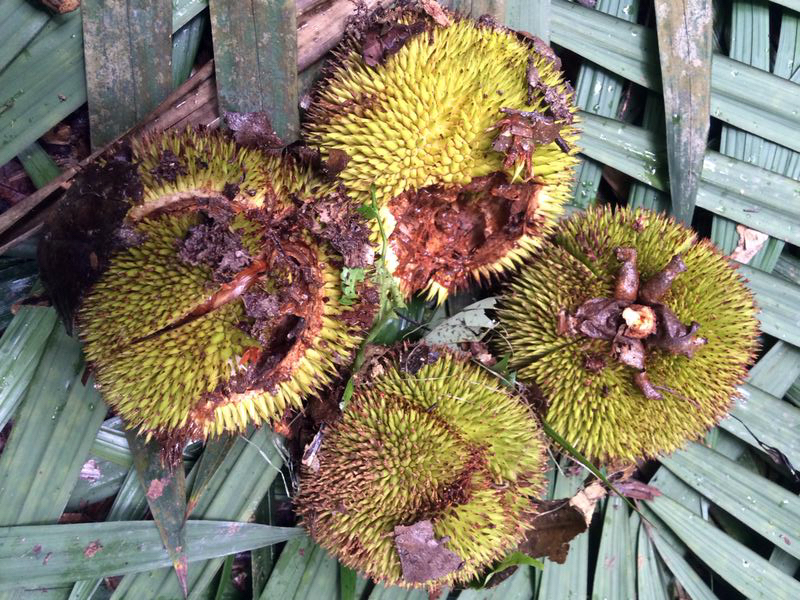
Ripened fruit of the Singapore Durian (Durio singaporensis) from MacRitchie Rainforest. Photo: Aminurashid bin Eksan.
The Singapore Durian grows in our rainforests and can reach 40m high. Too high for you and I to reach the small fruit about the size of a grapefruit. Just as well, as the ripe durian fruit splits open high up on the tree, and forest animals like monkeys love to feed on it. Yum yum!
Singapore Durian (Durio singaporensis) plant sapling (left) with distinctive leaf underside (right). A wild and endangered species of our rainforest. Photos: Dr Adrian Loo
The seeds have little flesh so humans don’t eat them, which means more food for the wild animals – yeah! This endangered durian tree is found only in Singapore and Peninsular Malaysia.
Can you imagine a tiny, spiky red durian? Our other native Durian tree, Durio griffithii, is no less special, as its teenie-weenie durian fruit is bright, fire-engine red in colour when ripe! The common name for this tree is Durian Burong (burong means bird in Malay) or Squirrel’s Durian. Unfortunately, this rare local durian tree of our forests is endangered as well.
The tiny fruit of the Durian Burong (Durio griffithii) turns from green to an unusual fire-engine red when ripe. Sadly, this rare wild durian of our rainforests is endangered. Photos: Lua Hock Keong
Like people, many wild animals such as small mammals, squirrels and birds love to feed on durian. Did you know that durian flowers are pollinated by bats and moths? Without their help, we would not have our beloved King of Fruits!
Lastly, did you know that we have a fake durian tree? Nope, this is not fake news! We have a super rare mock durian tree… but that’s another story for another day.
Let’s protect our last wilderness of Singapore with all it’s precious wildlife before its too late!
Acknowledgements: Many thanks to Dr Adrian Loo, Lua Hock Keong and Aminurashid bin Eksan for sharing photos, and to Joy Wong for her kind help.
‘Protect Our Last Wilderness’ is a conservation campaign by Cicada Tree Eco-Place. It highlights the pressing need to prevent the disappearance of the island’s last remaining wilderness areas, which are an important buffer against the effects of climate change. Protecting them is our moral responsibility. Learn more about the campaign today!
Christiane Amanpour: Did it have a silver lining in terms of how we figure out our place – we humans in the natural world – what we’ve done to potentially disrupt the natural world? Where do you think this could lead?
Jane Goodall: Well, the thing is that we’ve brought this on ourselves. A pandemic like this has been predicted, we’ve had epidemics galore, and it’s because we’ve disrespected the natural world and the animals who live there. And we cut down forests, animals are pushed closer together, some of them are pushed to crop-raid and things from the nearby villagers. This gives an opportunity for the viruses and bacteria to spill over from the animal host to human.
And then, in addition to that, we kill them, we eat them, we traffic them, we sell them in wildlife meat markets across Asia – which, by the way, most wet markets don’t sell live wild animals at all; they’re more like farmer’s markets – but anyway, these wildlife meat markets across Asia and the bush meat markets in Africa create ideal environments for these viruses and bacteria to hop over, to cross the species barrier and bind with whatever they bind with in the human to create a new disease like COVID-19.
And we should remember it’s not only the cruelty to the animals who are sold in tiny cages, often killed on the spot, vendors and customers contaminated with blood, urine, faeces, and so on, but then we’ve got our factory farms, that we’re breeding billions of animals in terrible, horrible, crowded, unsanitary conditions. And academics have started from factory farms as well as from these wildlife markets, so we have brought this on ourselves and people have known about it and been telling us about it, but we prefer to go on with business as usual to make money and attain power in the short term and not worry about future generations or the health of the planet.
BANGKOK: Preventing the further destruction of Southeast Asia’s forests will be a critical step to stopping the spread of future deadly viruses similar to COVID-19, according to leading experts studying the risk factors that have contributed to the current global pandemic.
Over the past four decades, swathes of the region’s pristine forests have been felled at astonishing rates. Agriculture and infrastructure have swallowed up land perennially owned by nature, in the vast pursuits of economic development.
A third of the region’s forest cover has been lost in that time. Humans and wild animals have come into closer contact and conflict.
Now, research shows more conclusively that the destruction and fragmentation of forest land is not only a leading cause of climate change. It is also linked to dangerous viruses jumping between animals and humans.
While the exact source of COVID-19 is yet to be established, its zoonotic origins, which make up 58 per cent of all infectious diseases, are not in question. More than two-thirds of zoonotic diseases are known to come from wild animals.
“Pandemic risk is linked to habitat loss and exploitation of wildlife. Spillover of zoonotic viruses is more common than we realise and is happening at a rate that is faster than ever, said Christine Johnson, a professor of epidemiology and ecosystem health at the University of California, Davis.
“As natural habitat is diminished, wildlife often redistribute into marginal habitats in closer and more frequent contact with people,” she said.
The professor has directed animal and human surveillance activities for PREDICT, part of USAID’s Emerging Pandemic Threats project, which recently uncovered previously undetected strains of coronavirus in bats in Myanmar.
Climate change – exacerbated by deforestation – is increasing the risk of disease emergence by pushing animals and the vectors that can transmit viruses into new regions that have not encountered those pathogens previously, she explained.
She said it has never been more important to recognise the connection between the health of the environment and global public health.
“Protection of natural habitats for wildlife and restriction of the live animal wildlife trade are going to be essential for mitigating disease emergence, which is the establishment of new viruses from animals into susceptible human populations, and, if viruses are human-to-human transmissible, can cause pandemics,” she said.
A recent Stanford University study looked at how landscape changes brought about by deforestation and the intensification of agriculture brought humans into closer contact with animals in Uganda. The research mapped a complex range of different behaviours and interactions to better understand where and how disease transmission could occur.
It is the type of information that could be helpful in an Asian context, the study’s lead researcher and doctoral candidate, Laura Bloomfield said.
“It represents the complex environmental, social and economic forces that are at play in many tropical forested areas across the world that have an increasing density of people and pressure on wild animal habitats,” she said.
While much of the blame for the inception of COVID-19 has fallen onto a single individual action at a wet market in Wuhan, China, Bloomfield said that simplistic explanation undermines the root cause of the spread of such viruses.
“It takes the focus away from the complex set of circumstances that lead to forest fragmentation, local dependence on forest resources, development, destruction of wild animal habitat, and human-animal contact. It is important to think about these events in a global context,” she said.
Ebola, Malaria and Lyme diseases are examples of damaging outbreaks that have origins with disrupted forest landscapes.
Research by the IDEAAL project – Infectious Disease Emergence and Economics of Altered Landscapes – conducted between 2013 and 2019 and mainly in Southeast Asia, estimates land-use change is the biggest driving factor of such diseases, in about one-third of all new cases.
That project aimed to put an economic cost on deforestation when linked with the spread of infectious diseases, notably Malaria, in Sabah, Peninsular Malaysia, Sarawak, and Thailand. In a final report, it concluded that net present value loss between 2015 and 2030 would exceed US$4.35 trillion if deforestation continues at business-as-usual rates.
CHANGE NEEDED IN HOW FORESTS ARE VALUED
Environmental campaigners in the region say there needs to be a fundamental change in the way forests are valued, in the face of ongoing rapid rates of deforestation. The benefits would be economic, environmental and health-related.
“You have competition for food security in the same landscapes. The economics of palm oil, you can’t compete with any other product right now. Everyone will continue to profit on palm oil and its expansion,” said David Ganz, the executive director of The Center for People and Forests (RECOFTC).
“I talk about bundling ecosystem services; we need to value not just the carbon but the water, the pollination values, the recreation values. You have to have full natural capital accounting so forests are really seen for their full value,” he added.
The challenges are steep in Indonesia, where it is estimated that more than one million hectares of rainforest are lost every year, mostly to palm oil, which is also being enthusiastically promoted by Malaysia.
President Joko Widodo’s proposed Omnibus law is expected to further slash environmental protections, such as permits and impact assessments, and further promote foreign direct investment in the palm oil sector.
On top of zoonotic disease spread, Arie Rompas, the Forest Campaign Team Leader for Greenpeace Indonesia, is also worried about the health impacts from plantation fires and the cascading impact on an already suffering economy.
“Potentially more land will be needed to be converted into palm oil plantation to meet the demand and this increases the risk of more fires and haze. Last year, the fires that broke across Indonesia released at least 708 million tonnes of carbon dioxide equivalent – nearly twice the amount of greenhouse gases as the Amazon fires,” he said.
“In 2019 the United Nations warned the Indonesian forest fires were putting nearly 10 million children at risk due to air pollution. Today, we are facing a global health crisis with a virus that affects people’s lungs.”
Rompas of Greenpeace said a lack of transparency is hiding crucial information from the public, which would otherwise “help fight deforestation and reduce emissions”.
“We need systemic change in how we run and fuel our society. We cannot continue to exploit nature at this global scale for short-sighted economic returns. Forest protection is now more important than ever for securing the health of people and the planet,” he added.
LOCAL COMMUNITIES REQUIRE PROTECTION
For Ganz of RECOFTC, empowering and protecting local communities – those at the literal front line of forest protection – should be front of mind once the pandemic is brought under control and investments start to flow once more in the region.
“These are marginalised people; they’re either indigenous groups or vulnerable people, particularly susceptible during the pandemic. They are the best stewards of our global forest estate. If we give them the keys to the car they’ll do a much better job than what governments are doing,” he said.
While these governments have made “pronounced” commitments to address the problems of forest management, land use and climate change, he is awaiting the willpower to back up those pledges with real action.
The widespread impacts of this pandemic are good enough reasons for why it must happen, Ganz believes.
“The health of the forest is tied to the health of human civilisation and the health of the planet. “The more large tracts of healthy forest that we keep as is, the better off we are. The more we displace animals by fragmenting the forest, the worse off it is,” he said.
“ If we start conveying that message and people get a newfound awakening, who knows?”